Tutor LMS vs LearnDash: which one, and when

On this page
Short answer: if you sell courses to individuals and want one plugin that does most of the job, start with Tutor LMS. If companies buy seats for their staff, or you need groups with leaders and reports and pass marks that gate what comes next, start with LearnDash. The rest of this article explains why, with the projects behind it.
This site has 15 projects tagged Tutor LMS and 17 tagged LearnDash. What follows are the patterns that repeat across the course platforms among them, not a feature list copied from either vendor.
The short version, in a table
| Question | Tends to favour Tutor LMS | Tends to favour LearnDash |
|---|---|---|
| Who pays? | Individual learners and parents | Companies buying seats for a team |
| Cost at launch | A free core plugin, Pro when you need it | A paid licence from day one |
| Who teaches? | Several instructors with front-end dashboards (co-instructors and revenue sharing come with Pro) | One academy, run by its own staff |
| Course rules | A clear sequence with quizzes and assignments; prerequisites, drip and required quiz passes come with Pro | Prerequisites, drip and pass marks in core, plus groups with leaders who see reports |
| Checkout | Tutor’s own checkout (subscriptions and bundles with Pro) or WooCommerce | Its own Stripe and PayPal payments, recurring included, or WooCommerce |
When Tutor LMS is the better start
Tutor LMS suits projects where learners buy for themselves and the owner wants courses, quizzes, a student dashboard and, with Pro, certificates, all from one vendor rather than a stack of third-party add-ons.
- SuperCar Haulers launched as a free membership: drivers sign up, land on a dashboard and work through video lessons structured as a Tutor LMS course, with WooCommerce installed for paid programmes later.
- Training Que groups certification courses by category, issues certificates on completion and limits downloads to authorised members.
- ReidFX runs courses with quizzes and assignments, gates premium material behind memberships, and adds risk and trading calculators built in PHP and JavaScript.
- Innovatutor sells tiered monthly class plans to parents through a custom WooCommerce setup, next to a form where tutors apply to teach.

The pattern: Tutor LMS covers the course side out of the box, and the custom work goes into how the business sells, such as plans, memberships and applications.
When LearnDash is the better start
LearnDash suits academies with rules: who may start which lesson, who passed, who manages whom. It is a paid plugin with a large add-on ecosystem, and its Groups feature is the base for selling to organisations.
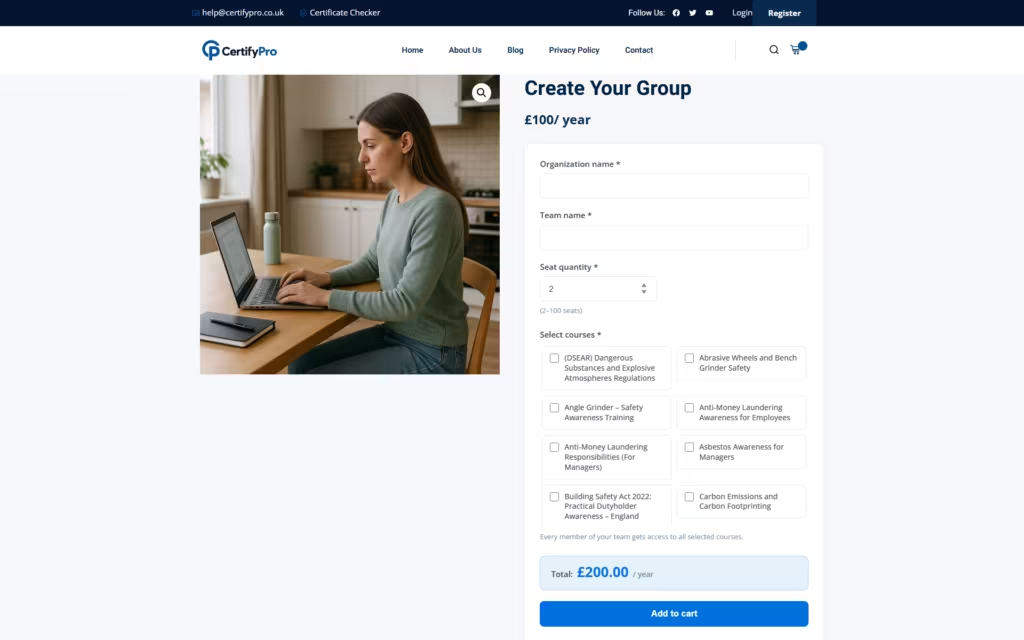
- CertifyPro Training sells workplace training to UK teams. Its group add-on asked buyers for a quantity on every course, so a custom product type replaced that with one seat count, three purchase modes and a yearly subscription that keeps seats in step, still on native LearnDash groups.
- French Immersion College needed live class batches that confirm at 10 paid learners and stop at 22, with a coordinator releasing each sublevel. LearnDash covered the courses; a custom plugin, French Path, covered the rest.
- Care Training Hub sells accredited care training with a white-label option for care businesses. Managers track staff on their own dashboards and lessons unlock in order.
- EBP Central Academy gates quizzes behind passing scores and issues continuing-education certificates automatically.
- CoachTribe combines LearnDash with subscription tiers, a 1 euro trial, and iDEAL and Bancontact payments.
The pattern: LearnDash’s structure carries academies that sell to organisations or enforce strict progress, and the custom work goes into the buying side and the parts LearnDash leaves to add-ons.
Where each one stopped on real projects
Both plugins needed help somewhere, and where they stopped is more useful than any feature grid.
- LearnDash and team buying. On CertifyPro the group add-on created one group per course and priced by course and quantity, while the client wanted one group, one seat count and price times seats. The fix was a focused plugin, not a different LMS.
- LearnDash and live teaching. On French Immersion College, LearnDash handled courses but not batches, seat limits, attendance or the daily work of teachers and coordinators, who also needed to work without wp-admin access.
- Tutor LMS and the way a business sells. On Innovatutor, tiered monthly plans that siblings can share (the Gold Plan gives 8 classes a month) needed custom product attributes and billing logic in WooCommerce, next to the Tutor LMS courses.
- Tutor LMS and gated extras. On ReidFX the courses ran on Tutor LMS, while the trading calculators were custom PHP and JavaScript and the premium material sat behind memberships.
Exam preparation is its own case
Sites that prepare people for a specific exam need timers, audio and scores that look like the real test. On the two documented exam-prep builds, both on LearnDash, those parts were custom: ExamenFrançais runs timed mock exams with audio listening sections for the TEF Canada and TEF IRN, and TCF Academy runs custom simulators with timers and weekly reports for the TCF Canada. In both, the simulator is the real work, so the LMS choice matters less than the budget for that part.
Payments differ by country
The LMS rarely decides how people pay; the market does. CoachTribe is a Dutch academy, so its checkout offers iDEAL and Bancontact. French Immersion College runs on Paystack. TCF Academy offers a manual verification route next to recurring subscriptions for learners without international payment methods. Settle the payment methods first, then pick the checkout, then the LMS that works with it.
What neither plugin decides for you
- The checkout. Both plugins now handle one-off sales and simple subscriptions in their own checkout (Tutor LMS with Pro, LearnDash with Stripe or PayPal). WooCommerce still made sense on Innovatutor, where plans that siblings share needed custom billing logic.
- Speed. The LMS is rarely the slow part of a course site. The theme and the add-ons stacked around it usually are.
- The missing piece. Both plugins stop somewhere. French Path beside LearnDash and the custom billing logic on Innovatutor both fill the gap without changing the LMS itself.
Can you switch later?
Yes, but plan for it. Some routes have a vendor tool: Tutor’s Migration Tool imports LearnDash courses, enrolments, progress and quiz attempts. Settings such as drip, certificates and old URLs still need mapping and checking on a staging copy. I wrote up what a move loses, and how to keep each part, in What LMS migrations lose, and the LMS Migration page explains how such a move is quoted.
Five questions that settle it on a call
- Who pays: the learner, a parent or an employer?
- Do you need groups with a leader who sees reports?
- Will more than one instructor publish courses?
- Must learners pass one step before the next opens?
- Which payment methods do your buyers expect?
If the answers point both ways, I lean towards the plugin that needs fewer add-ons for the must-haves, and a small custom plugin for the rest.
Planning a course site? See WordPress LMS Development, or the Tutor LMS and LearnDash pages for prices and more case studies.
The service behind this article
Need this built?
Tutor LMS Developerfrom $499 LearnDash Developerfrom $499 LMS Migrationfrom $499 Book a 30-min call All servicesRelated articles
Hiring a LearnDash developer: what to ask before you pay
Hiring a LearnDash developer? The questions that separate a safe build from an expensive one, what a good answer sounds like, and the red flags to watch.
Kajabi vs WordPress: what you pay, and what you own
Kajabi or your own WordPress site? What each costs to run in November 2026, what you can take with you when you leave, and when a move pays off.

Rebuilding my WordPress site: before and after, in numbers
The old home page loaded 19 stylesheets and 18 scripts. The rebuild loads 2 and 1. What changed, how it was measured, and five checks for your own site.